
Should You Rush for an MRI? Why Imaging Doesn’t Always Tell the Whole Story

What are the chances of a physiotherapist quoting Yoda as part of a therapeutic intervention?
Actually… quite high.
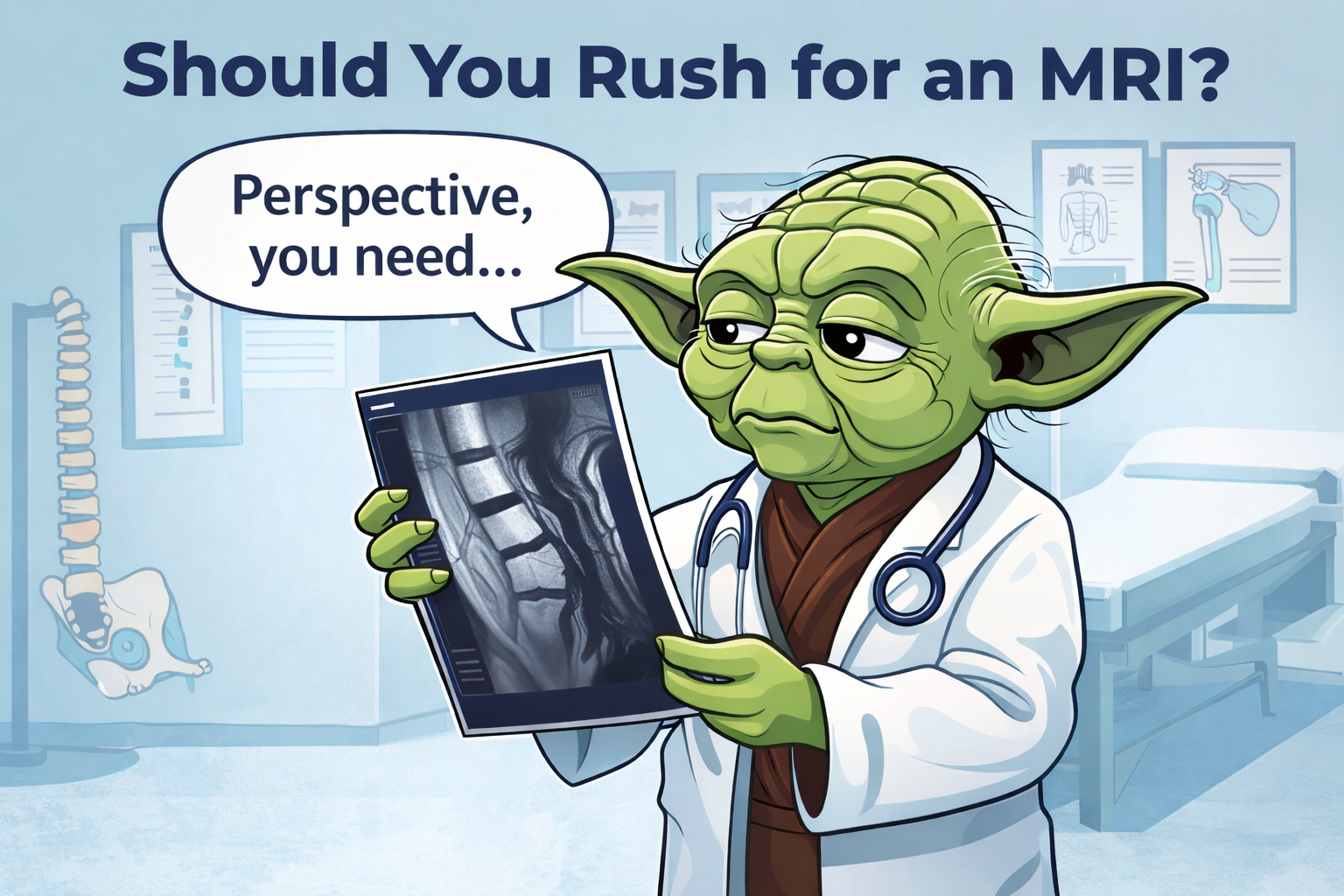
A few years ago, a radiologist walked into my treatment room holding her own MRI scan. She had been experiencing neck and arm pain for just over a week and, understandably, arranged an MRI for herself.
The distress on her face had little to do with the pain itself.
It appeared the moment she read the report:
“Disc bulge.”
Immediately her mind began racing. What does this mean? Will this get worse? Will I need surgery?
The problem wasn’t the scan.
The problem was what she thought it meant.
Imaging Findings Are More Common Than You Think
Her reaction is something we see often. Many patients feel anxious or overwhelmed when reading MRI, X-ray, or ultrasound reports.
Medical terminology can be confusing, and people often interpret findings through the lens of stories they have heard from friends, family, or the internet.
But here is something important to understand:
Many imaging findings are incredibly common in people who have no pain at all.
Across multiple joints, studies consistently show that structural changes frequently appear in completely pain-free individuals.
Examples include:
Lumbar spine disc bulges
Cervical disc degeneration
Hip labral tears
Knee meniscal tears
Rotator cuff tears in the shoulder
These changes are often considered normal age-related findings, similar to the changes you might notice when you look a little more closely in the mirror.
In many cases, these findings have likely been present for years before any symptoms appeared.
A Scan Shows Structure — Not Function
This does not mean imaging studies are useless. MRI, X-rays, and ultrasound scans can be incredibly valuable tools when used appropriately.
However, imaging only tells us part of the story.
A scan shows us what structures look like.
It does not tell us:
how strong you are
how your joints move
how sensitive your nervous system is
which movements reproduce your symptoms
what activities you can or cannot tolerate
how your body adapts to load
Those answers come from a valid and reliable clinical examination.
Without that context, imaging findings can easily be misunderstood.
When Scans Come Too Early
Sometimes the biggest problem is not the scan itself, but getting the scan before a proper assessment.
When imaging is done without guidance, the results can lead to unnecessary concern and confusion.
People may begin to worry that their body is “damaged”, even when the findings are normal variations that many healthy people have.
This can lead to:
- fear of movement
- avoidance of activity
- reduced confidence in the body
- unnecessary referrals for invasive procedures
In some cases, these misunderstandings can even contribute to unnecessary or ineffective surgical interventions.
Why Clinical Assessment Matters
A thorough physical examination allows us to understand the full picture.
We look at movement, strength, joint mobility, nerve function, and how symptoms behave during activity.
This information helps us determine whether the findings on a scan are actually relevant to the problem you are experiencing.
In many cases, symptoms respond well to simple interventions such as movement, education, and gradual loading.
What Happened to the Radiologist?
You might be wondering what happened to the radiologist who walked into my clinic with that MRI report.
After a careful assessment, it became clear that her symptoms were related to joint stiffness and irritation rather than a serious structural problem.
A few gentle mobilisations and guided movements later, her neck movement improved and her arm pain settled.
Just as importantly, understanding the meaning of her MRI findings helped relieve the fear she had experienced when reading the report.
A little education and the right perspective made a big difference.
In other words, she left the clinic feeling much more like a Jedi.
The Take-Home Message
If you feel worried or distressed after reading an MRI, X-ray, or ultrasound report, it may simply mean that the findings need to be placed into the right perspective.
Imaging can be helpful, but it should always be interpreted alongside a thorough clinical assessment.
A scan does not automatically explain your pain.
Sometimes the most important step is not getting another test, but understanding what your body is telling you.
And that is where a physiotherapist can help.
Need Some Perspective?
If you are concerned about imaging findings or unsure what your scan results really mean, a proper assessment can provide clarity.
Before jumping to conclusions, consider speaking with a physiotherapist who can interpret the findings in the context of your symptoms and movement.
Sometimes the Force you need is simply good clinical reasoning.