
“My Rotator Cuff Is Torn” – Why Your Scan May Not Tell the Whole Story
At GRB Physio, one of the most common and worrying phrases we hear is:
“My scan says my rotator cuff is torn… so that must be why I’m in pain.”
It sounds logical.
But modern research tells a very different story.
A “tear” on a scan does not automatically mean damage, dysfunction, or the need for surgery.
Torn Rotator Cuffs Are Common — Even Without Pain
A major 2025 systematic review published in the Journal of Orthopaedic & Sports Physical Therapy examined rotator cuff imaging in people with no shoulder pain at all.
The researchers found that:
Depending on age and population studied, up to 100% of pain-free individuals showed “abnormalities” on imaging, including rotator cuff tears.
In other words:
Many people walk around every day with “torn” rotator cuffs and feel perfectly fine.
No pain.
No limitation.
No treatment needed.
“My Scan Shows a Tear… Does That Mean It’s the Cause of My Pain?”
One of the most common assumptions we see is:
“If there’s a tear, that must be why it hurts.”
It makes sense on the surface.
But pain is rarely that simple.
Many people have rotator cuff tears and feel absolutely fine.
So when pain is present, the tear itself is often not the main driver.
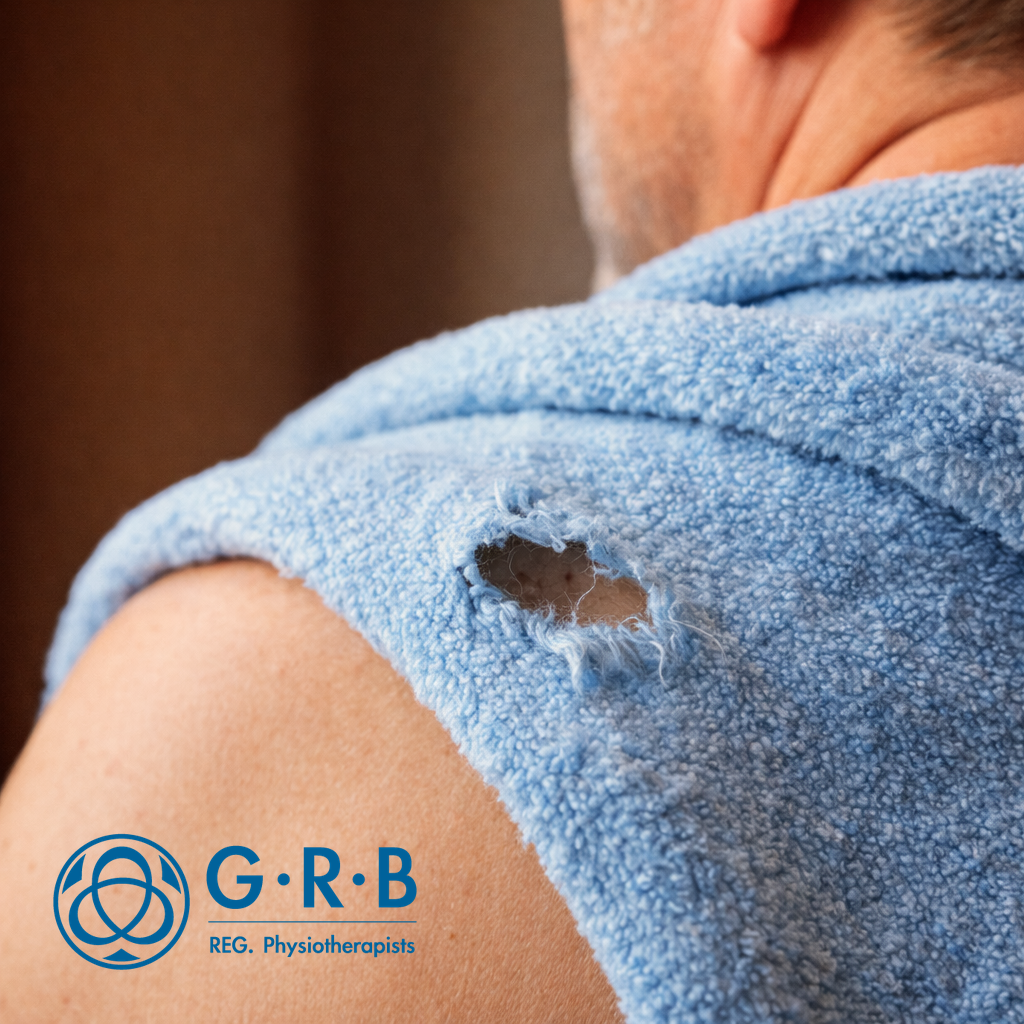
The Blanket Analogy: Wear Doesn’t Mean It’s Broken
Think about your favourite blanket.
You’ve used it for years.
It’s soft. It’s comfortable. It works perfectly.
Over time, it develops:
-
A few thin patches
-
Some fraying
-
A bit of wear and tear
But it still keeps you warm.
It still does its job.
Now imagine someone points out the wear to you:
“Look here… it’s worn.”
Suddenly, you start noticing it.
You become more aware of every mark.
You begin to worry if it’s “damaged”.
But the truth is:
That wear has probably been there for years.
It didn’t suddenly make you cold.
The blanket is still working.
If you’re cold, it might be because:
-
A door is open
-
A window is letting in wind
-
The heater is off
-
The temperature has changed
Not because of the blanket.
How This Applies to Your Shoulder
Your rotator cuff works in much the same way.
Over time, it may develop:
-
Small tears
-
Thinning
-
Degenerative changes
-
“Abnormalities” on scans
These changes are often normal parts of ageing and adaptation.
They may have been there for years without causing any pain.
You only became concerned when someone “showed you the wear”.
And suddenly:
-
You worry
-
You protect the shoulder
-
You move differently
-
You lose confidence
-
You avoid certain activities
But the “tear” itself may not be why you’re hurting.
Often, it’s more about:
-
Reduced strength
-
Poor load tolerance
-
Altered movement patterns
-
Fatigue and overuse
-
Loss of confidence
-
Other irritated tissues
Just like the open door, not the blanket.
Why We Are Sharing This With You
We share this because we don’t want you to:
-
Panic after seeing a scan
-
Assume surgery is inevitable
-
Stop exercising unnecessarily
-
Lose trust in your body
-
Make decisions based on images alone
Instead, we want you to:
-
Understand what your scan means
-
Focus on what you can change
-
Get the right guidance
-
Rebuild confidence
-
Move forward safely
Scans Inform Care — They Don’t Define It
Imaging is useful.
But it is only one part of the puzzle.
A scan cannot tell us:
-
How strong you are
-
How you move
-
What your goals are
-
How confident you feel
-
What your lifestyle demands are
That’s why at GRB Physio, we prioritise clinical assessment first, not just reports.
We treat people, not pictures.
Take-Home Message
A “torn rotator cuff” on a scan:
Does not equal permanent damage
Does not mean surgery
Does not mean you must stop moving
It means you need good guidance.
And that’s what we’re here for.
Let’s Assess Your Shoulder Properly
If you’ve been worried by a scan report, don’t make decisions alone.
Let us help you understand what it means for you.
Phone: 012 664 6128
Website: www.grbphysio.com
GRB Physio – Evidence-based care. Real-world results.
Reference
Sanders S, Ibounig T, Haas R, Jones M, Rämö L, Docking S, Järvinen T, Taimela S, Hoffmann T, Buchbinder R.
Rotator Cuff Imaging Abnormalities in Asymptomatic Shoulders: A Systematic Review.
Journal of Orthopaedic & Sports Physical Therapy. 2025;55(12):1–16.
doi:10.2519/jospt.2025.13611